 University of Agriculture and Forestry, Hue University
University of Agriculture and Forestry, Hue University
University of Agriculture and Forestry, Hue University
HUAF Shares Knowledge on AI and IoT for Smart Food Production
On August 7, 2026, the seminar “Green Transformation, Digital Technology and Sustainable Nutrition” was held in Ho Chi Minh City, bringing together a large number of scientists, experts, and businesses working in food technology, digital technology, equipment, and innovation. The seminar was jointly organized by the Vietnam Association of Food Science and Technology (VAFoST) and VINEXAD as part of the Vietnam International Exhibition of Food & Beverage – Processing Technology, Equipment, Packaging, and Food & Beverage.
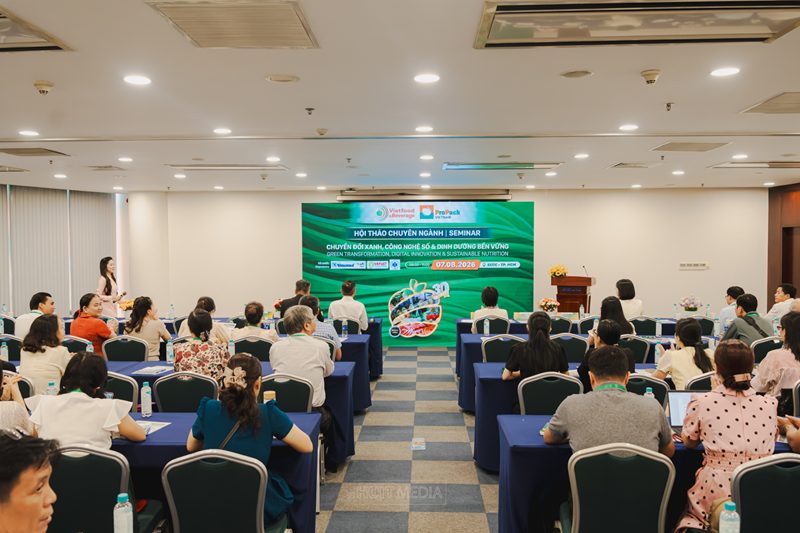
Representing the University of Agriculture and Forestry, Hue University (HUAF), Assoc. Prof. Dr. Nguyen Van Toan, Dean of the Faculty of Engineering and Food Technology, attended the seminar together with relevant faculty members. At the event, Assoc. Prof. Dr. Nguyen Van Toan delivered a presentation entitled “Applications of AI and IoT in Optimizing Food Processing”, highlighting the role of Artificial Intelligence (AI) and the Internet of Things (IoT) in monitoring, data analysis, and process optimization in food production in line with the development of Industry 4.0.
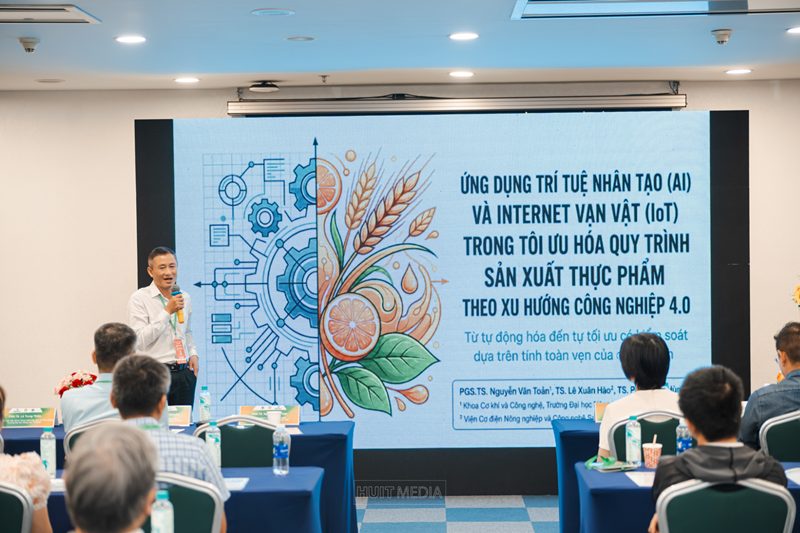
Assoc. Prof. Dr. Nguyen Van Toan, Dean of the Faculty of Engineering and Food Technology, delivering his presentation
The presentation emphasized the importance of integrating data from sensors, control systems, and management software to support decision-making throughout various stages of food production, including drying, pasteurization, fermentation, packaging, cold-chain management, and equipment maintenance. AI can analyze data in real time, predict production conditions, and recommend optimized solutions, thereby improving production efficiency while ensuring food quality and safety requirements.
One of the key messages highlighted at the seminar was that people remain at the center of smart factories. AI and IoT serve as tools to support data processing, forecasting, and recommendation, while humans continue to be responsible for monitoring, control, and final decision-making, particularly in matters related to food quality and safety.
From an educational perspective, the convergence of food technology, mechatronics, automation, sensors, AI, and IoT is creating new demands for technical and technological human resources. This direction is also consistent with the development orientation of the Faculty of Engineering and Food Technology in training human resources capable of adapting to smart factory environments, digital transformation, and modern production systems.
Through academic activities and professional networking, HUAF continues to strengthen knowledge exchange and expand cooperation with experts, professional associations, and businesses. At the same time, the University promotes interdisciplinary research and education that are closely aligned with practical needs and emerging trends in modern production.
One of the key messages highlighted at the seminar was that people remain at the center of smart factories. AI and IoT serve as tools to support data processing, forecasting, and recommendation, while humans continue to be responsible for monitoring, control, and final decision-making, particularly in matters related to food quality and safety.
From an educational perspective, the convergence of food technology, mechatronics, automation, sensors, AI, and IoT is creating new demands for technical and technological human resources. This direction is also consistent with the development orientation of the Faculty of Engineering and Food Technology in training human resources capable of adapting to smart factory environments, digital transformation, and modern production systems.
Through academic activities and professional networking, HUAF continues to strengthen knowledge exchange and expand cooperation with experts, professional associations, and businesses. At the same time, the University promotes interdisciplinary research and education that are closely aligned with practical needs and emerging trends in modern production.
Key: was held, on august, organized by, and innovation, association of, the vietnam, the seminar, 2026 the, seminar green, transformation digital, technology and, sustainable nutrition, in ho, chi minh, city bringing, large number, of scientists, experts and, businesses working, in food, technology digital
Newer articles
Older articles
HUAF tries its best to become as the prestigious university. Additionally, HUAF always makes great efforts in training to provide localities and enterprises with qualified human resources. It is highly appreciated as a good center in science and technology to contribute the development of socio- economics to the whole country in integration tendency.
- Online175
- Today502
- This month516
- Total18,850,102